
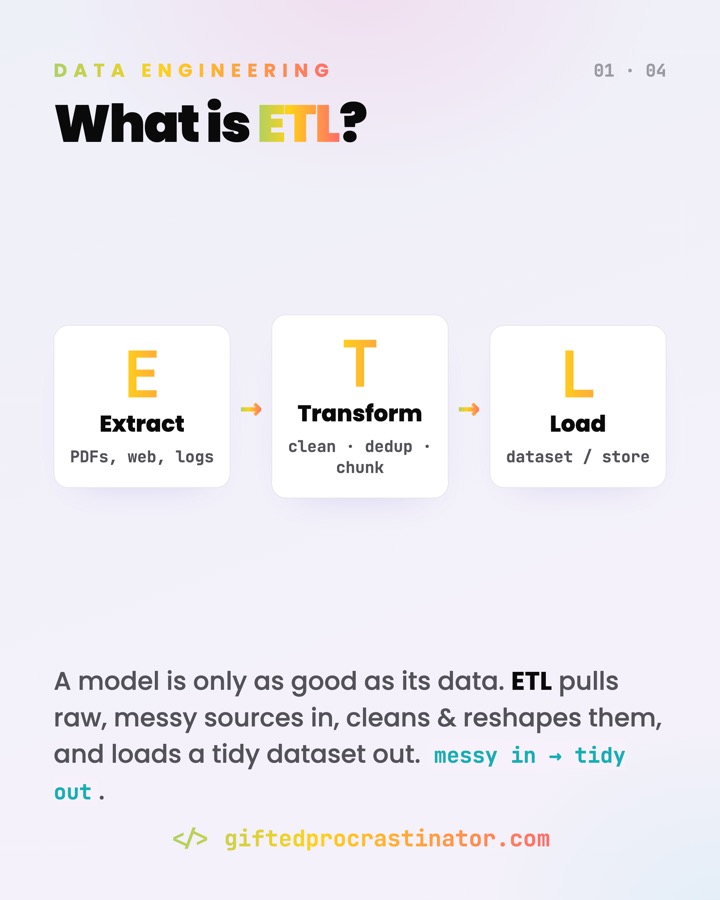
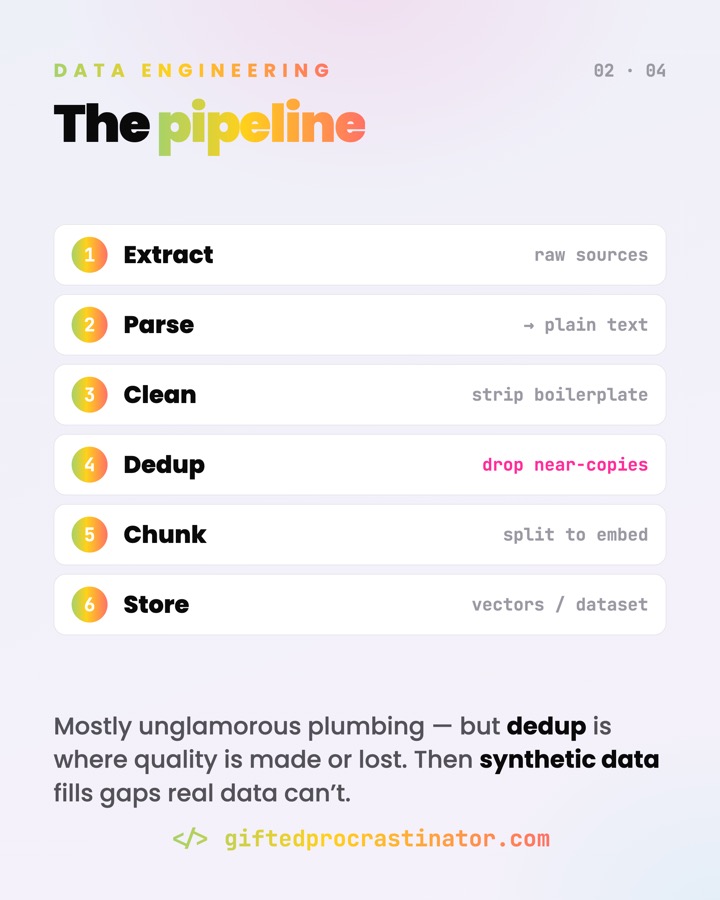
ETL is the plumbing that gets data from where it lives to where it's useful. Extract it from messy sources, transform it into a clean shape, load it into a warehouse or database. When real data is missing or too sensitive to use, synthetic data manufactures a stand-in.
Where you meet it
- Nightly jobs that pour app databases, logs, and APIs into an analytics warehouse.
- Building the training set for a model — the pipeline the cards walk through.
- Sharing a realistic dataset without leaking real customers: ship synthetic rows instead.
- Testing and demos that need plausible data before the real thing exists.
What it does
ETL moves and reshapes data on a schedule, so analysts and models query one trustworthy table instead of ten raw, conflicting ones. Synthetic data fabricates records that mimic the statistics of the real ones — same distributions, same correlations — without copying any actual person.
Synthetic data copies the statistics, not the people — but it inherits the biases too, and isn't private until you measure it.
How it works
The pipeline runs in three moves:
- Extract — pull rows from databases, files, APIs, event streams.
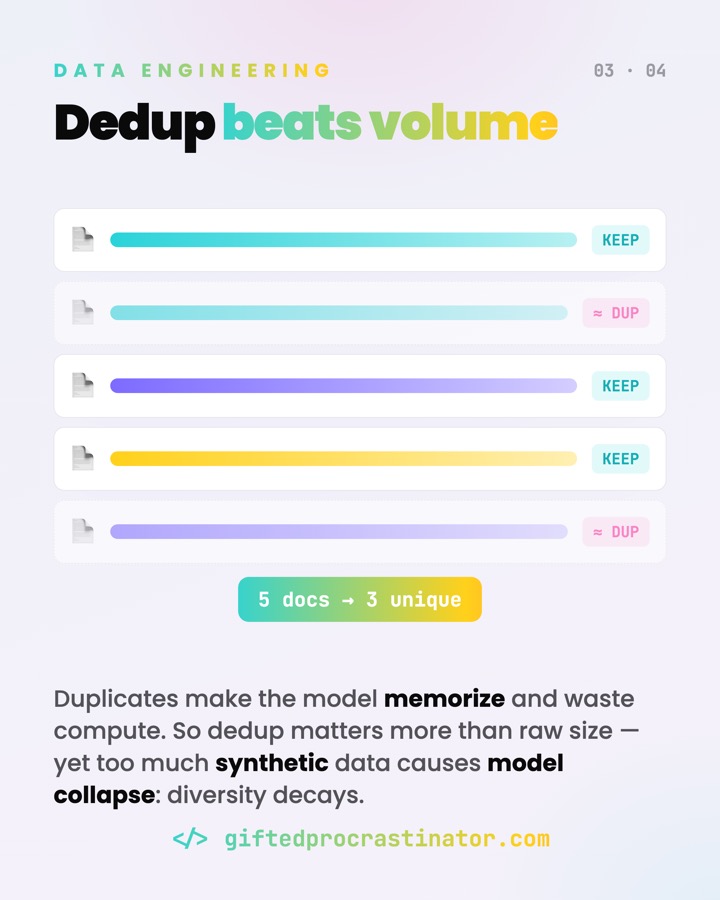
- Transform — clean nulls, dedup, fix types, join sources, aggregate. The unglamorous 80%.
- Load — write the result into the target store.
ETL vs ELT is just when you transform. Classic ETL transforms before loading, on a separate box. Modern ELT loads raw data straight into a cloud warehouse and transforms there with SQL (the dbt model) — cheaper compute makes "load first, clean later" practical for big, messy data.
Pipelines don't run themselves. An orchestrator like Airflow models the work as a DAG — tasks with dependencies — and runs it on a schedule, retrying failures and tracking what already succeeded.
Synthetic data comes in three flavours, increasingly realistic:
- Rule-based — fake names, IDs, addresses from templates.
- Sampling from distributions — draw numbers from a fitted Gaussian or histogram. scikit-learn's
make_classificationsamples Gaussian clusters around a hypercube. - Generative models — train a model on real data, then sample new rows that share its joint distribution (SDV's tabular synthesizers).
Watch out
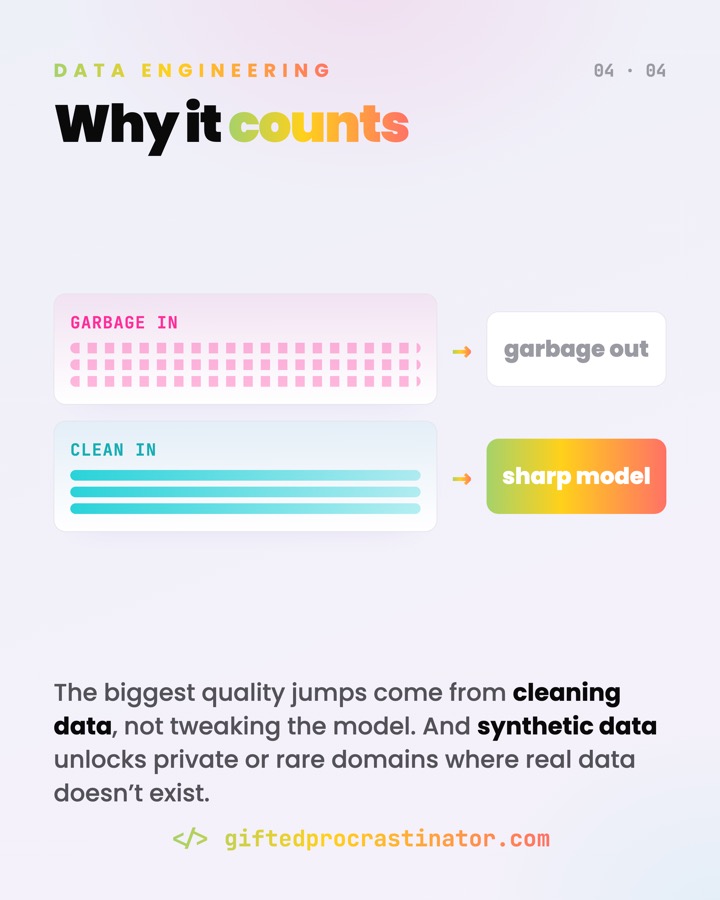
- Garbage in, garbage out. No model recovers from a broken pipeline — validate and test your data, not just your code.
- Make pipelines idempotent and reproducible: re-running a job must give the same result, not double-counted rows.
- Synthetic data inherits the biases of the original. If the real data skews, so does the fake — and bias can amplify on resampling.
- Synthetic ≠ private by default. Generative models can memorise and leak rare real records; privacy must be measured, not assumed.
Go deeper
ETL ist die Klempnerei, die Daten von dort holt, wo sie liegen, dorthin, wo sie nützen. Aus chaotischen Quellen extrahieren, in saubere Form transformieren, in ein Warehouse oder eine Datenbank laden. Fehlen echte Daten oder sind sie zu sensibel, erzeugt synthetische Daten einen Ersatz.
Wo es vorkommt
- Nächtliche Jobs, die App-Datenbanken, Logs und APIs in ein Analytics-Warehouse kippen.
- Den Trainingsdatensatz für ein Modell bauen — die Pipeline, die die Karten durchgehen.
- Einen realistischen Datensatz teilen, ohne echte Kunden zu verraten: synthetische Zeilen statt echter.
- Tests und Demos, die plausible Daten brauchen, bevor es die echten gibt.
Was es tut
ETL bewegt und formt Daten zeitgesteuert um, damit Analysten und Modelle eine vertrauenswürdige Tabelle abfragen statt zehn rohe, widersprüchliche. Synthetische Daten fabrizieren Datensätze, die die Statistik der echten nachahmen — gleiche Verteilungen, gleiche Korrelationen — ohne eine reale Person zu kopieren.
Synthetische Daten kopieren die Statistik, nicht die Menschen — erben aber auch deren Bias und sind nicht privat, bis du es misst.
Wie es funktioniert
Die Pipeline läuft in drei Zügen:
- Extract — Zeilen aus Datenbanken, Dateien, APIs, Event-Streams ziehen.
- Transform — Nulls säubern, deduplizieren, Typen korrigieren, Quellen joinen, aggregieren. Die unspektakulären 80%.
- Load — das Ergebnis in den Ziel-Store schreiben.
ETL vs. ELT ist nur die Frage wann transformiert wird. Klassisches ETL transformiert vor dem Laden auf einer separaten Maschine. Modernes ELT lädt rohe Daten direkt ins Cloud-Warehouse und transformiert sie dort per SQL (das dbt-Modell) — billige Rechenleistung macht "erst laden, dann säubern" praktikabel für große, chaotische Daten.
Pipelines laufen nicht von allein. Ein Orchestrator wie Airflow modelliert die Arbeit als DAG — Tasks mit Abhängigkeiten — und führt sie zeitgesteuert aus, wiederholt Fehlschläge und merkt sich, was schon geklappt hat.
Synthetische Daten gibt es in drei Geschmacksrichtungen, zunehmend realistisch:
- Regelbasiert — falsche Namen, IDs, Adressen aus Vorlagen.
- Sampling aus Verteilungen — Zahlen aus einer angepassten Gauß-Verteilung oder einem Histogramm ziehen. scikit-learns
make_classificationsampelt Gauß-Cluster um einen Hyperwürfel. - Generative Modelle — ein Modell auf echten Daten trainieren und dann neue Zeilen sampeln, die dessen gemeinsame Verteilung teilen (SDVs Tabellen-Synthesizer).
Worauf achten
- Garbage in, garbage out. Kein Modell erholt sich von einer kaputten Pipeline — validiere und teste deine Daten, nicht nur deinen Code.
- Pipelines idempotent und reproduzierbar bauen: ein erneuter Lauf muss dasselbe Ergebnis liefern, keine doppelt gezählten Zeilen.
- Synthetische Daten erben die Verzerrungen des Originals. Ist die echte Verteilung schief, ist es die künstliche auch — und Bias kann sich beim Resampling verstärken.
- Synthetisch ≠ privat per se. Generative Modelle können seltene reale Datensätze auswendig lernen und durchsickern lassen; Privatsphäre muss gemessen, nicht angenommen werden.