
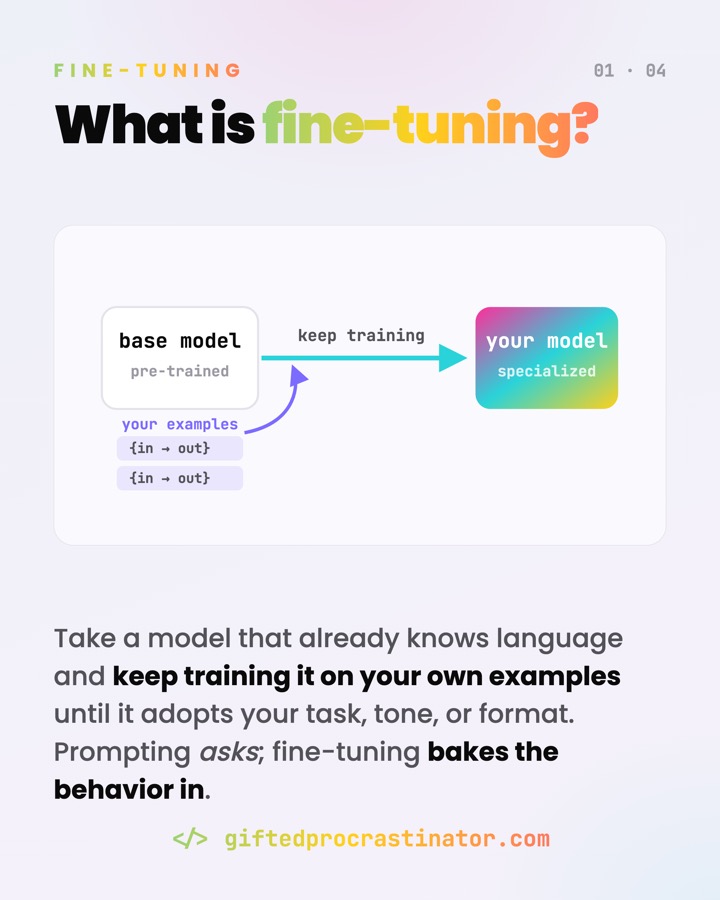
Fine-tuning keeps training an already-capable model on your own examples until it reliably adopts a task, format, or style you couldn't pin down by prompting alone.
Where you meet it
- Locking a model to a fixed output shape — strict JSON, a house tone of voice, a domain's terminology.
- Squeezing a smaller, cheaper model into a narrow task a big model handled via long prompts.
- Adapter ecosystems — one frozen base, many swappable LoRA adapters, one per task or customer.
What it does
It takes the weights of a pre-trained model and nudges them with supervised (input → output) examples, so the behavior you were spelling out in the prompt gets baked into the model itself. The result needs shorter prompts and behaves more consistently.
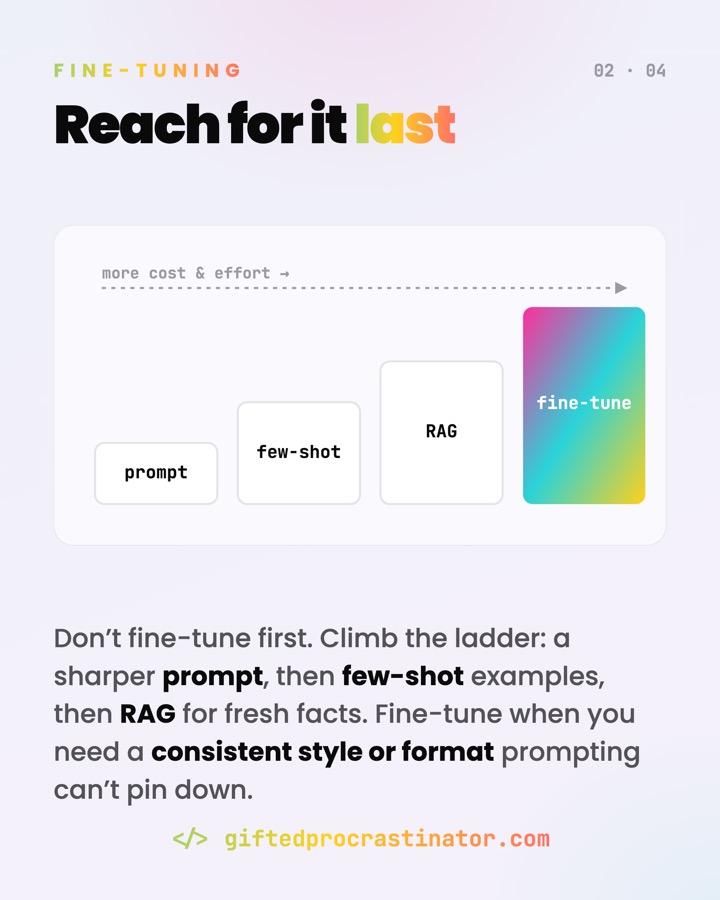
Fine-tuning teaches a model how to behave, not what's true — for fresh facts, reach for RAG instead.
How it works
You continue training the pre-trained model with a smaller learning rate on domain- or task-specific (input → output) pairs, so it adapts without erasing what it already knew.
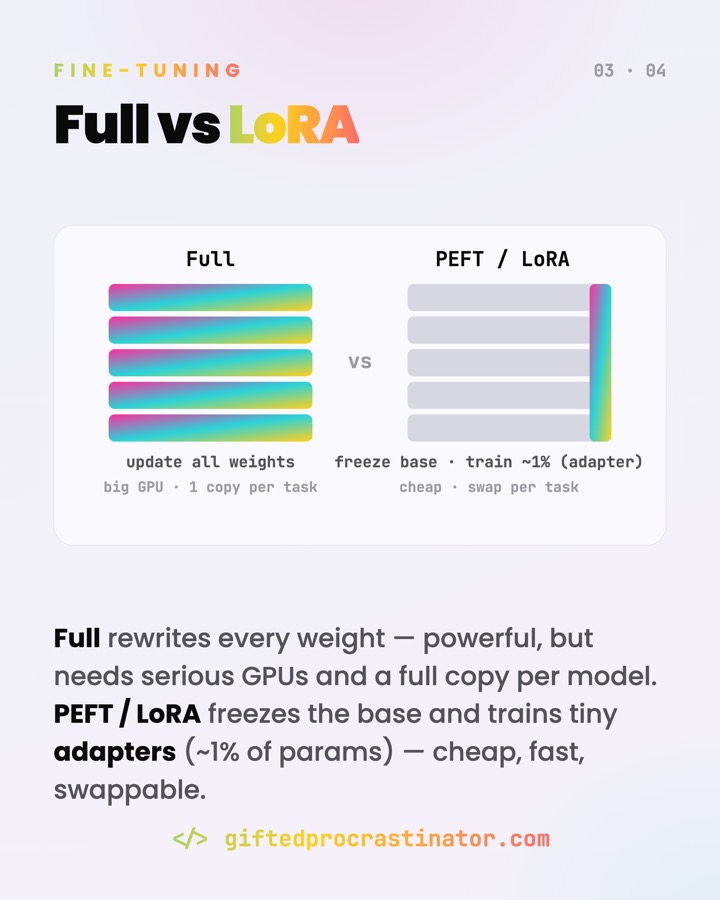
full fine-tuning   → update ALL weights      (powerful, expensive)
PEFT / LoRA        → freeze base, train a few (cheap, swappable)
                     extra params (adapters)
Full fine-tuning updates every weight and stores a complete copy per task — strong but GPU-hungry. PEFT/LoRA freezes the base and trains a tiny set of added parameters (typically well under 1% of the weights; LoRA reports up to a 10,000× cut vs. full tuning of GPT-3), tuning style, format, and specialized behavior for a fraction of the cost.
Watch out
- It's the last step, not the first. A sharper prompt, few-shot examples, or RAG usually get you there cheaper — official guides put prompting first.
- It teaches behavior and format, not facts. For fresh or factual knowledge reach for RAG; fine-tuning won't reliably memorize new data.
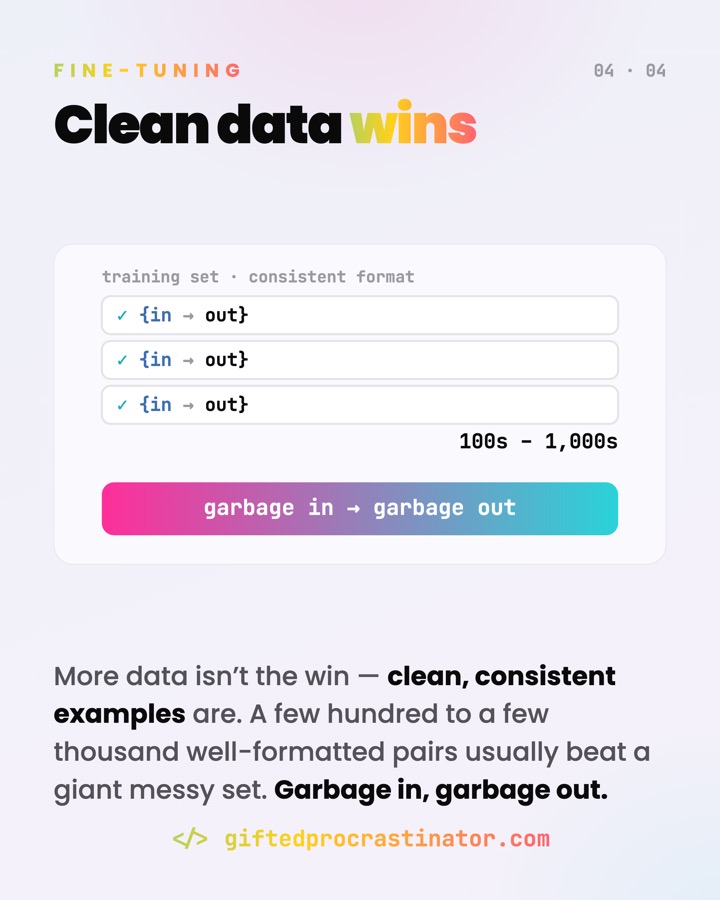
- It lives or dies on clean, consistent data plus a real eval — garbage in, garbage out, and no eval means you're flying blind.
- Mind catastrophic forgetting and overfitting, plus the upkeep: every base-model upgrade means re-tuning and re-validating.
Go deeper
Fine-Tuning trainiert ein bereits fähiges Modell mit deinen eigenen Beispielen weiter, bis es zuverlässig eine Aufgabe, ein Format oder einen Stil übernimmt, den du per Prompting allein nicht festnageln konntest.
Wo es vorkommt
- Ein Modell auf eine feste Ausgabeform festlegen — striktes JSON, ein Haus-Ton, die Terminologie einer Domäne.
- Ein kleineres, billigeres Modell auf eine enge Aufgabe trimmen, die ein großes Modell nur über lange Prompts schaffte.
- Adapter-Ökosysteme — eine eingefrorene Basis, viele tauschbare LoRA-Adapter, einer pro Aufgabe oder Kunde.
Was es tut
Es nimmt die Gewichte eines vortrainierten Modells und justiert sie mit überwachten (Eingabe → Ausgabe)-Beispielen, sodass das Verhalten, das du sonst im Prompt ausbuchstabiert hast, ins Modell selbst eingebrannt wird. Das Ergebnis braucht kürzere Prompts und ist konsistenter.
Fine-Tuning bringt einem Modell bei, wie es sich verhält — nicht was wahr ist. Für frische Fakten ist RAG zuständig.
Wie es funktioniert
Du trainierst das vortrainierte Modell mit einer kleineren Lernrate auf domänen- oder aufgabenspezifischen (Eingabe → Ausgabe)-Paaren weiter, damit es sich anpasst, ohne das Vorwissen zu zerstören.
Full Fine-Tuning → ALLE Gewichte ändern       (mächtig, teuer)
PEFT / LoRA      → Basis einfrieren, wenige   (günstig, tauschbar)
                   Zusatz-Params trainieren (Adapter)
Full Fine-Tuning aktualisiert jedes Gewicht und speichert eine ganze Kopie pro Aufgabe — stark, aber GPU-hungrig. PEFT/LoRA friert die Basis ein und trainiert nur wenige Zusatzparameter (typischerweise deutlich unter 1% der Gewichte; LoRA berichtet bis zu einer 10.000-fachen Reduktion gegenüber Full Tuning von GPT-3) und passt Stil, Format und spezialisiertes Verhalten zu einem Bruchteil der Kosten an.
Worauf achten
- Es ist der letzte Schritt, nicht der erste. Ein schärferer Prompt, Few-Shot-Beispiele oder RAG bringen dich meist günstiger ans Ziel — offizielle Guides setzen Prompting an die erste Stelle.
- Es lehrt Verhalten und Format, keine Fakten. Für frisches oder faktisches Wissen ist RAG zuständig; Fine-Tuning memoriert neue Daten nicht zuverlässig.
- Es steht und fällt mit sauberen, konsistenten Daten plus echter Eval — garbage in, garbage out, und ohne Eval fliegst du blind.
- Achte auf Catastrophic Forgetting und Overfitting sowie die Wartung: Jeder Wechsel des Basismodells bedeutet erneutes Tunen und Validieren.