
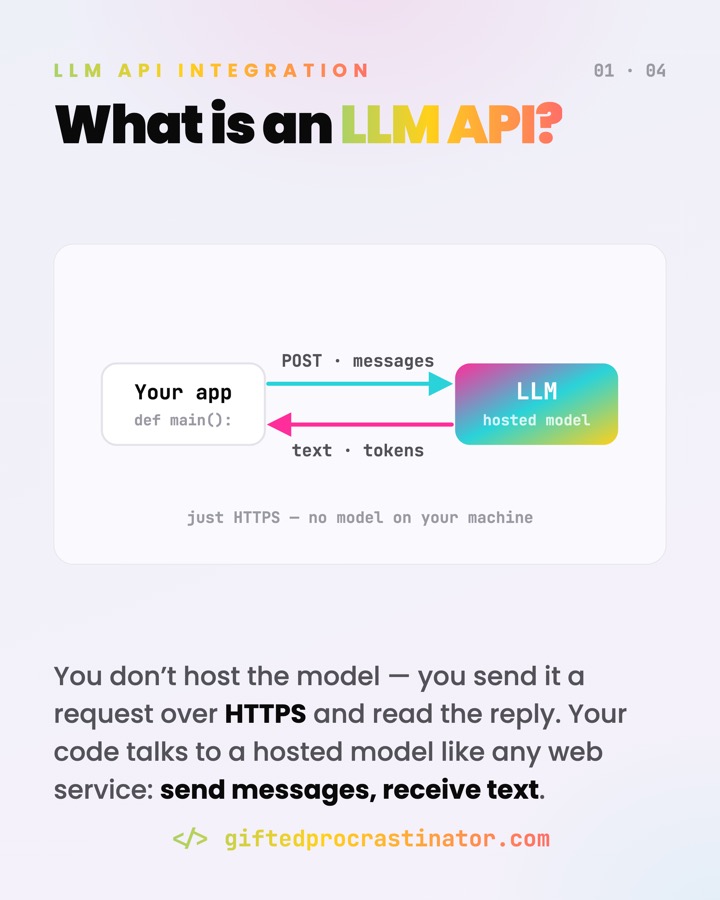
Calling an LLM is one HTTPS request: you send a list of messages, the model sends back text. No model runs on your machine — you POST JSON to a hosted endpoint and read the reply, like talking to any web service.
Where you meet it
- Chatbots and assistants — wiring a model behind your own UI.
- Pipelines that summarise, classify, extract, or rewrite text at scale.
- Agents and tool-use loops that call the API again and again with growing context.
- RAG systems — retrieve documents, stuff them into the prompt, ask the model.
What it does
It turns a conversation into a completion. You hand the model the whole exchange so far — each turn tagged with a role — plus a few knobs, and it returns the next assistant turn. The API is stateless: it remembers nothing between calls, so you carry the history.
The API remembers nothing — every call ships the full transcript, and every token, both ways, lands on your bill.
How it works
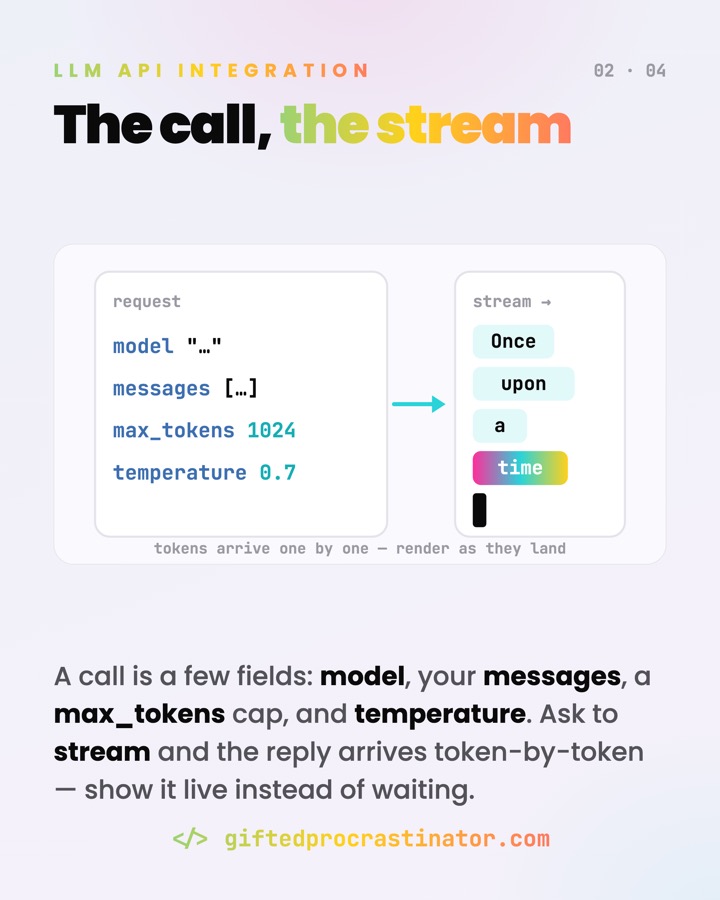
The request body is JSON: a model id, a messages array, and parameters like max_tokens (a hard cap on the reply) and temperature (higher = more random). Each message has a role — user and assistant alternate; the system instruction sets behaviour up front (Anthropic puts it in a top-level system field; OpenAI-style APIs put it as the first message). The API key rides in a header, never in the body.
POST https://api.anthropic.com/v1/messages
x-api-key: $ANTHROPIC_API_KEY        # secret, server-side only
anthropic-version: 2023-06-01
content-type: application/json

{
  "model": "claude-sonnet-4-5",
  "max_tokens": 1024,
  "temperature": 0.7,
  "system": "You are a terse assistant.",
  "messages": [
    {"role": "user",      "content": "Name one Scottish island."},
    {"role": "assistant", "content": "Skye."},
    {"role": "user",      "content": "And one more?"}
  ]
}
The reply is JSON: the generated content, a stop_reason, and a usage block with input/output token counts. Because there's no server-side memory, the third turn only works if you resend turns one and two — every call ships the full transcript. Set "stream": true and the response arrives as server-sent events (SSE): small token deltas you concatenate and render live, instead of blocking until the whole answer is done.
Watch out
- Never ship the key. API keys belong on a server or in env vars — never in frontend code, a public repo, or a git history. A leaked key is someone else's bill. Call the API from your backend and proxy.
- Stateless means you own the context. Resending the whole history each turn grows the token count fast — trim, summarise, or window old turns to stay under the context limit and the budget.
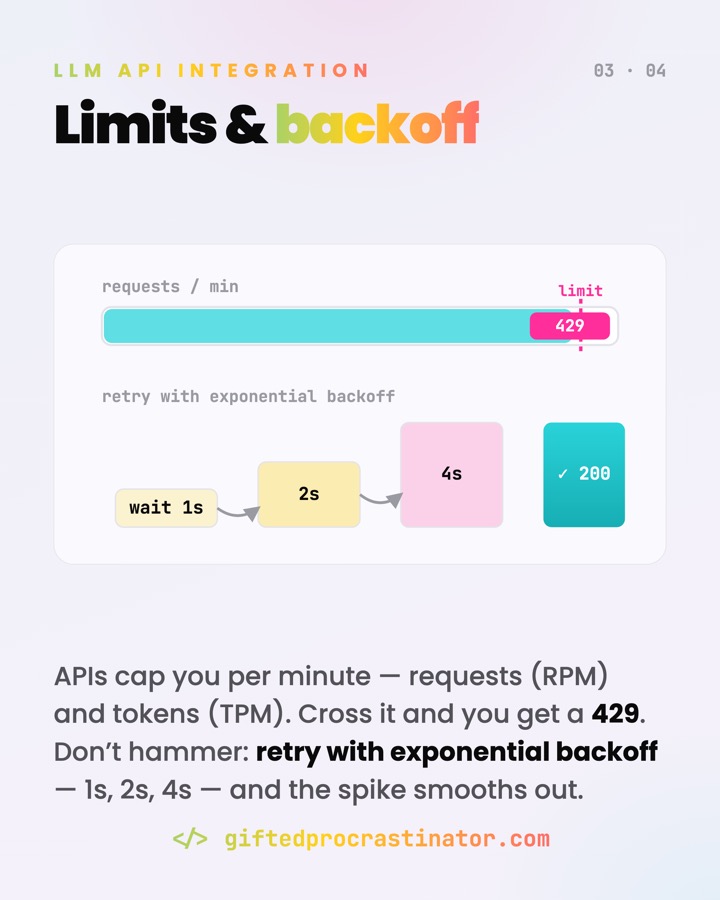
- Rate limits are real. Cross the per-minute request (RPM) or token (TPM) ceiling and you get
429. Retry with exponential backoff (1s, 2s, 4s, with jitter); also handle529/overloaded and500. - Validate the output. The model is non-deterministic and can change between versions — parse defensively, pin a model id, and don't
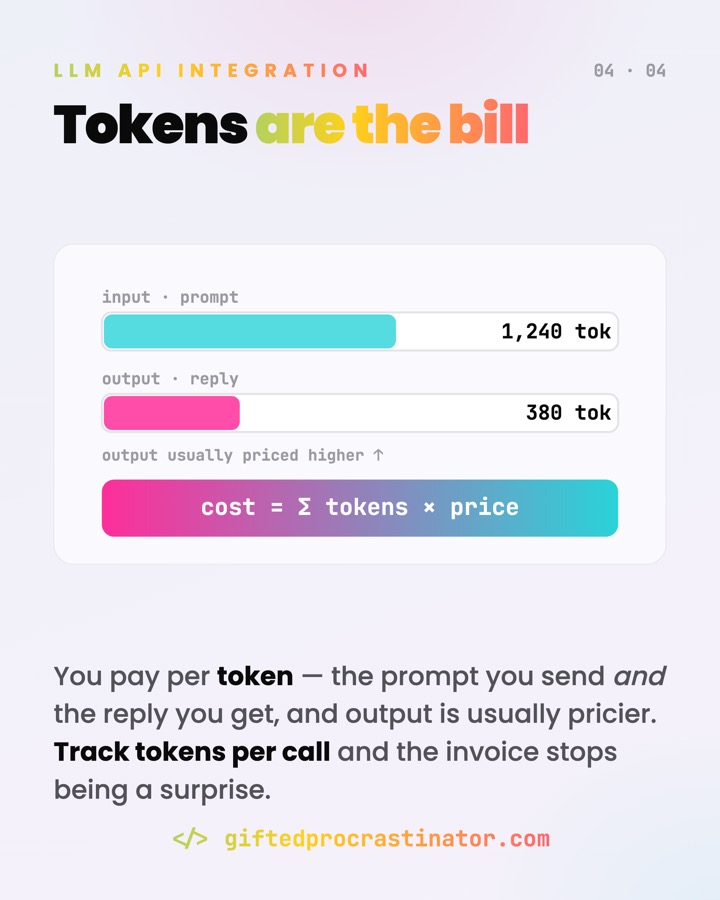
eval()what comes back. - You pay per token, both ways. Input and output are billed, and output usually costs more — read
usageon every call and watch the total.
Go deeper
Eine LLM aufzurufen ist ein einziger HTTPS-Request: Du schickst eine Liste von Nachrichten, das Modell schickt Text zurück. Es läuft kein Modell auf deiner Maschine — du POSTest JSON an einen gehosteten Endpoint und liest die Antwort, wie bei jedem Webservice.
Wo es vorkommt
- Chatbots und Assistenten — ein Modell hinter deine eigene UI hängen.
- Pipelines, die im großen Stil zusammenfassen, klassifizieren, extrahieren oder umschreiben.
- Agents und Tool-Use-Schleifen, die die API immer wieder mit wachsendem Kontext aufrufen.
- RAG-Systeme — Dokumente abrufen, in den Prompt packen, das Modell fragen.
Was es tut
Es macht aus einer Konversation eine Completion. Du übergibst dem Modell den bisherigen Verlauf — jeder Turn mit einer Rolle markiert — plus ein paar Stellschrauben, und es liefert den nächsten assistant-Turn. Die API ist stateless: Sie merkt sich zwischen Calls nichts, also trägst du die History.
Die API merkt sich nichts — jeder Call schickt das ganze Transkript mit, und jedes Token, in beide Richtungen, landet auf deiner Rechnung.
Wie es funktioniert
Der Request-Body ist JSON: eine model-ID, ein messages-Array und Parameter wie max_tokens (harte Obergrenze für die Antwort) und temperature (höher = zufälliger). Jede Message hat eine role — user und assistant wechseln sich ab; die system-Anweisung legt das Verhalten vorab fest (Anthropic in einem Top-Level-Feld system, OpenAI-artige APIs als erste Message). Der API-Key steckt im Header, nie im Body.
POST https://api.anthropic.com/v1/messages
x-api-key: $ANTHROPIC_API_KEY        # geheim, nur serverseitig
anthropic-version: 2023-06-01
content-type: application/json

{
  "model": "claude-sonnet-4-5",
  "max_tokens": 1024,
  "temperature": 0.7,
  "system": "Du bist ein knapper Assistent.",
  "messages": [
    {"role": "user",      "content": "Nenne eine schottische Insel."},
    {"role": "assistant", "content": "Skye."},
    {"role": "user",      "content": "Und noch eine?"}
  ]
}
Die Antwort ist JSON: der erzeugte content, ein stop_reason und ein usage-Block mit den Token-Zahlen für Input und Output. Weil es kein serverseitiges Gedächtnis gibt, funktioniert der dritte Turn nur, wenn du Turn eins und zwei mitschickst — jeder Call transportiert das ganze Transkript. Mit "stream": true kommt die Antwort als Server-Sent Events (SSE): kleine Token-Deltas, die du zusammensetzt und live renderst, statt zu blockieren, bis die ganze Antwort fertig ist.
Worauf achten
- Den Key niemals ausliefern. API-Keys gehören auf einen Server oder in Env-Variablen — nie in Frontend-Code, ein öffentliches Repo oder die Git-History. Ein geleakter Key ist die Rechnung von jemand anderem. Ruf die API vom Backend aus auf und proxye.
- Stateless heißt: Kontext ist deine Sache. Die ganze History pro Turn mitzuschicken treibt die Token-Zahl schnell hoch — alte Turns kürzen, zusammenfassen oder fenstern, um unter Kontext-Limit und Budget zu bleiben.
- Rate-Limits sind echt. Über das Minuten-Limit für Requests (RPM) oder Tokens (TPM) gibt's
429. Retry mit exponentiellem Backoff (1s, 2s, 4s, mit Jitter); auch529/overloaded und500behandeln. - Output validieren. Das Modell ist nicht-deterministisch und kann sich zwischen Versionen ändern — defensiv parsen, eine Modell-ID pinnen und nichts
eval()en, was zurückkommt. - Du zahlst pro Token, in beide Richtungen. Input und Output werden abgerechnet, Output meist teurer — bei jedem Call
usagelesen und die Summe im Blick behalten.